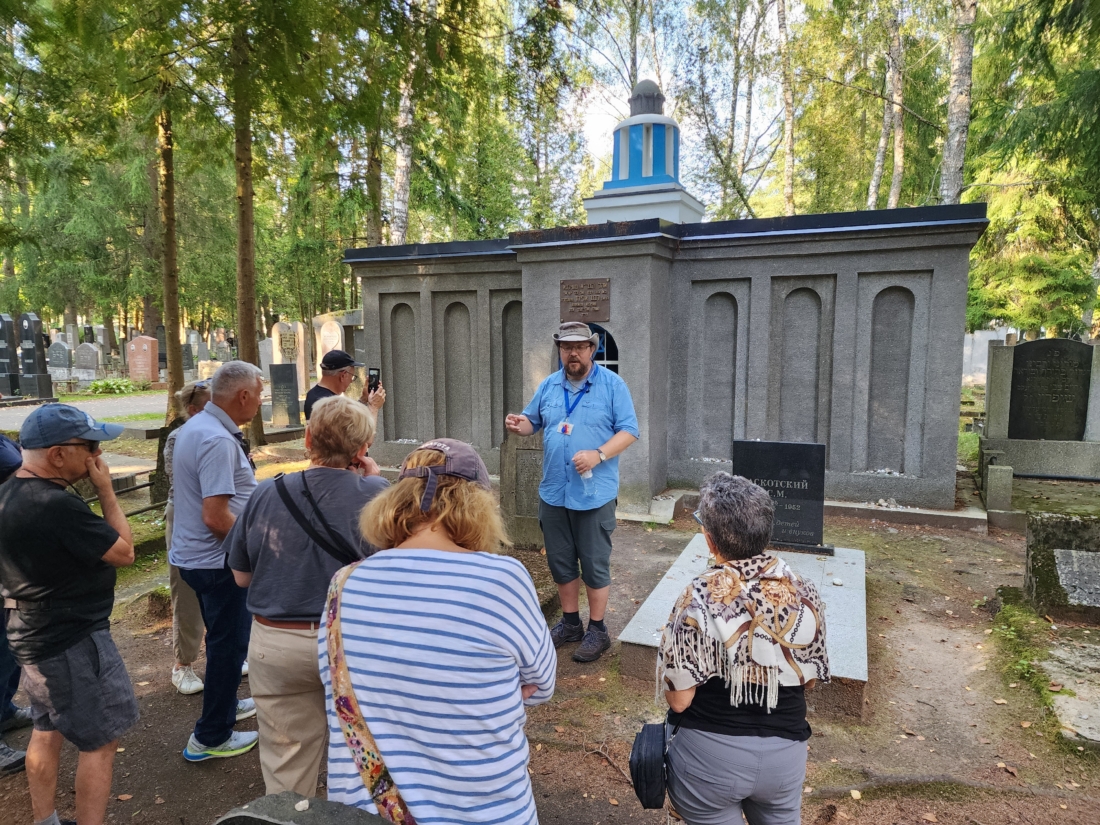
The day began with a charge, our tour guide Ernest said. This venture, and its two parts, should
“provide the historical context of Vilna.”
Representing our morning and afternoon excursions, the two pieces consisted of a walking tour
of Vilnius’ Old Town and chartered bus ride to several Jewish cemeteries.
Standing on Pilies Street, a historic road dating to the 16th century, we were told that although
Lithuania’s origins stretch more than 1,000 years, its modern history began in 1918 with the
Council of Lithuania adopting the Act of Independence of Lithuania.
Our 14-member group listened to Ernest, as he described wars, conquests and land
amassments. Between identifying Gothic, Renaissance and Baroque buildings, Ernest
interspersed anecdotes. As we ambled the historic path, his vignettes delivered shape to places
and people we could only imagine. Yes, throughout the morning, our guide dutifully shared
dates and called attention to placards and markers, but perhaps most helpful was a comment
Ernest made early Sunday morning. Standing in the Old Town at Cathedral Square, he said, “Every stone has a legend.”
In a city paved in cobble that’s a lot of tales.
As we made our way past Gediminas Castle Hill, the Presidential Palace and Vilnius University,
Ernset narrated stories about churches, blood libels and Jewish medical students. While
passing the former Jewish Quarter, Ernest articulated more tales: about the Vilna Gaon (a
Lithuanian talmudist who used his influence to stem the rise of Hasidism), about Judith
Montefiore (a philanthropist, author and wife of Moses Montefiore) and about the Ger Tzedeck
(a righteous convert and disciple of the Vilna Gaon).
Our guide shared facts — like before the war, Vilnius possessed the most significant library of
Jewish texts, that between the two World Wars there were 130 registered synagogues in
Vilnius, and that the Great Synagogue here could hold as many as 5,000 people — and more
tales.
When we arrived at the “Jewish street,” Ernest told us the road is “more in memory.”
After the war, the Soviets bulldozed it, he said. It’s the same thing they did to synagogues and
cemeteries, he added.
Ernest pointed to a fenced off heap of matzevot — the Jewish grave markers were used as
building materials but later salvaged by local landsmen wishing to preserve their history.
Walking through a place that was and appreciating what it used to be requires a knowledge of
history and some perspective.
Before concluding day one we were told that given the city’s communal significance and robust
culture, pre-war Vilnius was often called the “Jerusalem of Lithuania.”
The moniker mirrors our guide’s claim: “Every stone has a legend.”