
When you walk in Ponary there are sounds: the crackling of leaves beneath your feet, the strike
of a lighter as a flame ignites, the placing of a memorial candle near a marker.
That’s what we heard in the Ponary Forest.
Kazimierz Sakowicz heard something else.
The Polish-born journalist, we were told, had relocated to Ponary, a Lithuanian town located
less than 15 kilometers from Vilnius, shortly after the war began. From his attic, Sakowicz heard
a gunshot. Then he heard more. And more.
The reporter did what reporters often do; he documented. He detailed the frequency of killings.
The dates. The trucks. The supposed numbers of people. Sakowicz brazenly went so far as to
meet the Lithuanian collaborators to those crimes and chronicle the interactions.
In those days, paper was hard to come by so Sakowicz’s notes were scrawled on anything
retrievable, we were told. Discovery of his reports would be damning, so the journalist placed
the writings in bottles and hid them beneath his home.
Sakowicz reported for years. He wrote and buried; and no one heard. Before the war ended,
Sakowicz was killed by a “stray bullet,” we were told.
His wife moved to Poland. The bottles were unearthed decades later. Fragments of writings
were pieced together. Yad Vashem heard and requested the materials — the Jerusalem-based
memorial institution received them in 1991.
By July 1944, as many as 75,000 people were killed at Ponary, “the vast majority of them Jews,”
according to the U.S. Holocaust Memorial Museum.
Standing in the forest, we heard sounds today. Some expected, some not. Will we bury them?
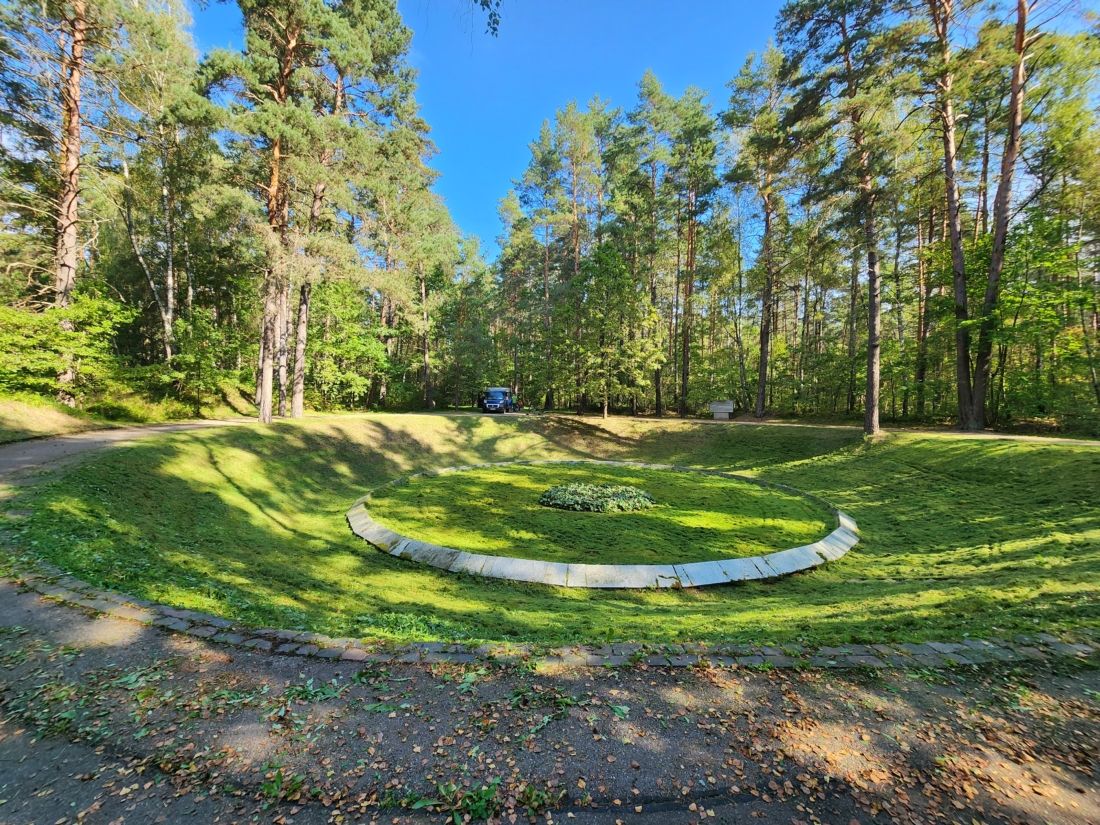
A pit in the Ponary Forest where thousands were murdered during the Holocaust. Photo by Adam Reinherz