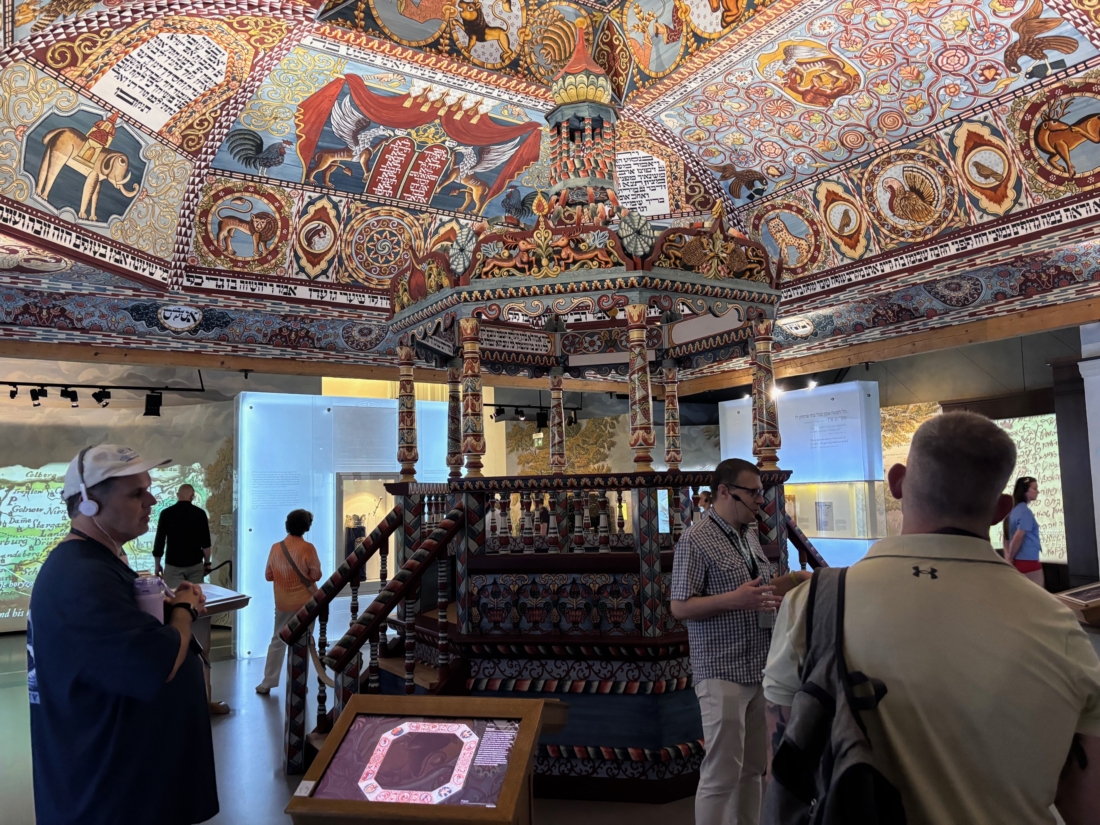
As Bus 2 rolled across a bridge over the shallow Vistula River, our tour leader Haim explained that in the upcoming three-hour visit to the Polin Museum, we would learn 1000 years of Jewish history in Poland. As a history teacher more used to teaching a millennia of history over an entire school year, it seemed inconceivable that this would be achieved in such a short time. But due to the intriguing exhibits and artifacts at the Polin Museum and the great efforts of our museum guide Mariusz Jastrzab, our group emerged more informed and ready to dive deeper into our study of the Jewish experience in Poland.
Our journey began in the mystic medieval forests of Poland. Here, in the 10th century, Jews fleeing pogroms in Western Europe were welcomed in and given the protection of the kings. In these forests, they heard the word “Polin” echoing through the trees, which they interpreted as the Hebrew phrase “Po-lin” meaning “Here you shall rest” which was interpreted as a divine sign. Given the conditions to flourish, the Jewish community grew and established itself as a vital part of the Polish economy. A 13th century coin with a Hebrew inscription reflected an important element of the relationship between Jews and Polish Christians- through their trade connections, Jews provided access to rare metals to lords and kings and served as critical middlemen in trade and crafts such as running taverns for the lords. Despite the protections offered by the nobility, Jews still faced restrictions such as the inability to own land. While I read this before in textbooks, the exhibit put this is sharper perspective. It was clear that in denying Jews access to own farmland was not just about Christian landowners not wanting to compete economically. In the Middle Ages, land was tied to political power and higher status in the feudal hierarchy. Denying Jews land ownership reflected religious prejudices, as was seen in other restrictions such as requiring Jews to wear identifying clothing and hats.
In the early modern period of the 16th and 17th centuries, we explored if this was truly the Paradisus Iudaeorum, or Jewish European Golden Age, as was often depicted in the literature. While Jewish cultural life thrived under self-government and an atmosphere of relative religious toleration, Jews still were denied full citizenship and membership in guilds. While still protected by nobility, as they were critical to the economy, Jews facing increasing persecution by Polish burghers and peasants and conspiracies of the blood libel and desecration of hosts lead to accusations where up to 300 Jews were executed. This is evidenced in the Khmelnytsky Uprising of the late 17th century, in which ravaging Cossacks devastated Jewish communities throughout Poland and Ukraine. Despite these terrors, Jewish life held on in Poland, as was shown by recreations of wooden colorfully painted synagogue and a Jewish household.
In the 19th century, modernization brought challenges to Jewish customs. Facing more severe restrictions as citizens of the now Russian empire, Jews were forbidden to emigrate further east and needed permissions to dress in traditional clothing. A split began to emerge in Jewish society as some elites defended modernization, promoting assimilation into industrial society and joining in modern schooling while orthodox Hasidim communities advocated for traditional customs and self-segregation from the greater Polish society. It was interesting to learn that the rise in xenophobic and antisemitic attacks of the late 19th and early 20th centuries were increasing directed more against those Jews who had acclimated themselves into modern Polish society. By the 1930s, Jews in Poland numbered over 3.5 million and made up 10% of the population. Despite the rich explosion of Jewish culture in the 1920s and 1930s, as shown in museum exhibits of a music club and the new film industry, Jews facing more restrictions as Europe struggled in the Depression. Here in Poland, Jewish children faced the “bench ghetto” in schools, segregated in their classroom seating. In the 1930s Poland’s government became increasing authoritarian and nationalistic and scapegoating of Jews increased, especially following the death of Jozef Pilsudski, the father of the Second Polish Republic, who championed a pluralistic, multi-ethnic Poland, and was seen as a protector of the Jewish communities.
This tour brought us up to the precipice of the Holocaust, where we paused for the day.
After all, we had 1000 years of Jewish history in Poland to think about first.