I can’t believe it’s been six days since first arriving in Poland. I could have posted
reflections earlier, because there’s been so much ground covered every single day. I’m
glad I waited until today to post, because it’s an indication of all of the places we’ve
seen, and also because it’s taken that long for me to attempt to synthesize and
articulate the impact of this trip.
The results so far have been an impressive and horrific and beautiful understanding of
both what life was like here for the Jewish people before the Holocaust and the great
loss to both Poland and humanity that the Nazis caused over such a short period of time
over eight decades ago.
The progression of excursions has been deliberately planned and has had the desired
effect. Our hotel for the first three days was adjacent to what was once the Warsaw
Ghetto. On day one we went to the POLIN Museum and were treated to a series of
displays documenting the history of Polish Jewish history for 1000 years. At the end of
the tour, it was evident that life here was so much different for so long until one man’s
institutionalized dystopian vision burnt it to the ground in an historical instant. Reflecting
on just that museum alone makes a person realize just how precious the contributions
of a single culture can be.
If that were the only place we visited, it would have been enough to understand the
fragility of life and the sadness of how much was lost forever. But that was only the
beginning of the day, before we went to an enormous Jewish cemetery, where we
engaged in an exercise to find Jewish symbolism of mourning and honoring the
deceased. One of the high school students in our group was even able to find her great
aunt there who died of the Spanish flu over 100 years ago and we were able to watch a
ceremony honoring her. Later that evening we had a beautiful dinner honoring 100 year-
old Ana, who was honored by Yad Vashem for her families’s role in sheltering Jews from
the Warsaw Ghetto. I have to admit that on that first day, though I took copious notes
hour after hour, I decided in the following days that I would rely mainly on photographs
to document the seminar, because I wanted to have more of an immersive experience
rather than an academic one. My first intention was to write down everything that I saw
and heard and felt, but it was too difficult logistically and I think the energy it took to
document everything on the first day drained my tank.
On day two we spent the day walking through what was once the Warsaw Ghetto.
Because Avi had recommended both The Pianist and A Film Unfinished, walking
through that area of the city left a tremendous impact on me. I could imagine the sites,
the sounds, the smells, the thoughts, and the feelings of dread of nearly half a million
people surrounding me in that same space not that long ago. And as we moved through
the ghetto throughout the day, different noble personalities emerged, and I imagined so
many artists, intellectuals, doctors, mothers, fathers, sisters, brothers, who were the
result of thousands of years of shared Jewish heritage. Then going to the spot where
the ghetto inhabitants were sent to Treblinka, I remembered the horrific scene in The
Pianist, where people gathered awaiting the trains that they were told would send them
to a work camp. I remember the hope that people expressed while waiting for a train
that would send them not to another life, but to the end of it.
If I went into all of the details of everything I’ve seen in this blog post, it would be
thousands of words, and maybe I should reserve those mostly for myself, but I wanted
to at least give a sense to anyone who reads this of the tremendous effect that
Classrooms without Borders can have on an individual person.
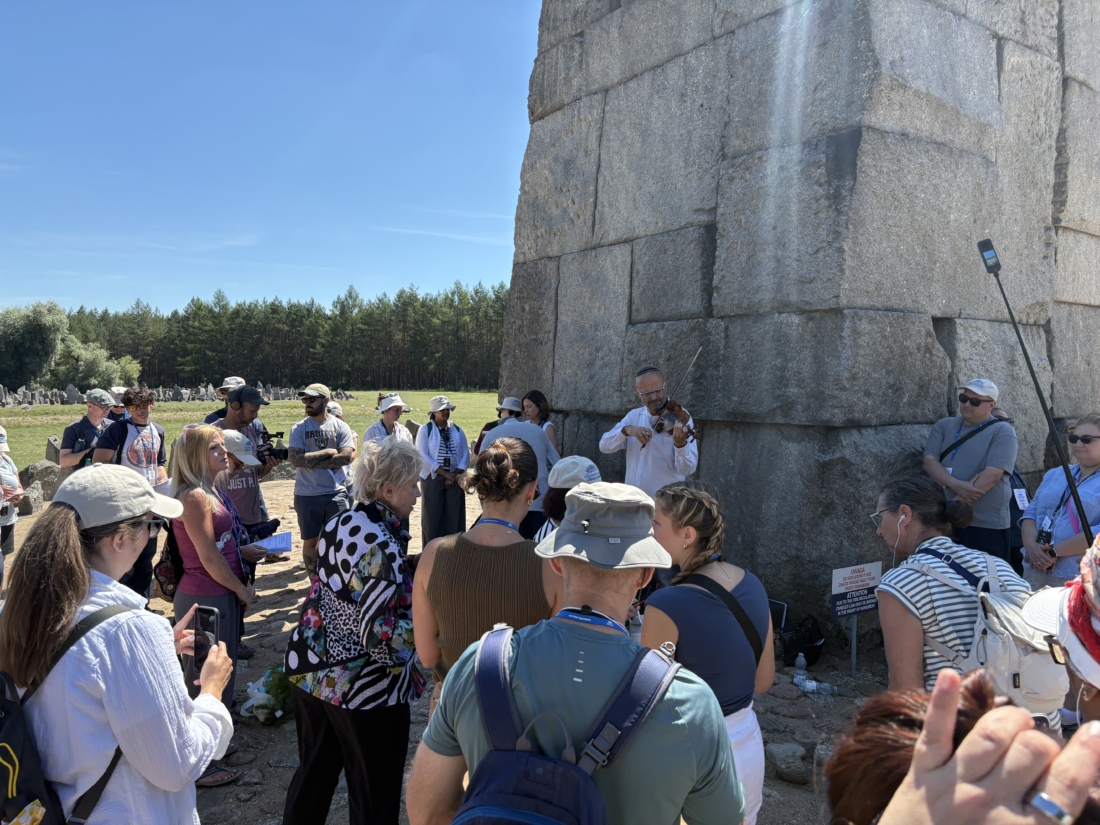
When we finally went to Treblinka on day three, it all came together. Because I’ve read
many books on the topic and seen Shoah twice before this trip, I fully expected to have
to fight back tears upon arrival at my first death camp. But I didn’t cry, so I asked myself
what’s wrong with you? Why don’t you just let the horror of this place overwhelm you
like you thought it would? And then I realized that I was so wrong to expect sadness as
my dominant emotion. This is partly because I had already cried over the years while
reading memoirs and watching Shoah, but also because what that site made me feel
was anger. Anger at at the Nazis and the Holocaust deniers today. And I felt the same
at Majdanek and Auschwitz. And on the other hand, I felt like it was wrong of me, even
disrespectful, to cry at the death camps, as a non- Jew, when several the Jewish friends
around me were visibly upset. I felt it was not my place to share in their mourning or
display an inkling of grief on my face. It just felt like I was a stranger at another family‘s
funeral. How inappropriate would it be for me to cry when it was their time to mourn?
And so I watched the faces of the Jewish members of the group in order to learn as
much as I could about what that place meant to them, trying to learn while stewing in my
fury.
That evening, at our hotel in Lublin we gathered in groups of 15 to reflect on what we
had seen so far. The result was an emotional coming together between all of us, and
because one person had a guitar and another had a violin, the evening erupted into
singing and good vibes. It occurred to me the importance of studying history firsthand,
because in just 72 hours all of these strangers were now hugging and singing together
over a common cause. Suffice it to say that has never happened to me in my life. We all
come from different backgrounds, but are shared interest in understanding this biggest
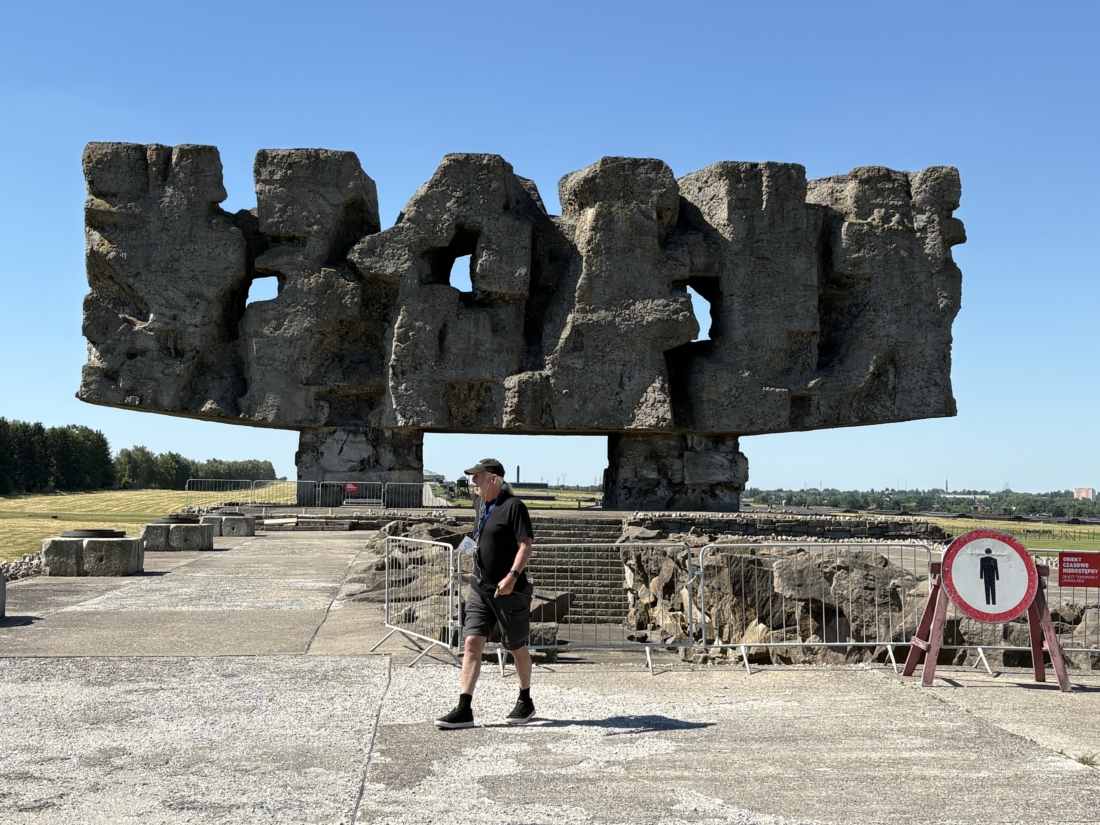
crime in world history became a force of nature for us all. The next day, day four, we
went to Majdanek, the smallest of the six death camps, but the most preserved one.
The horror and the depravity of the Nazi extermination system was on full display in a
place where over 130,000 people were killed, and this place represented 1/50 of the full
scale of the Holocaust. When you go to a place like this, when you see the gas
chambers intact and the crematorium intact, you feel a sense of dread because you’re
walking in the same footsteps of those who perished there.
Auschwitz-Birkenau, Day 6, was the most intense for me. Several others here as well as
friends who’d visited Poland before, said that Majdanek was the most intense for them.
Auschwitz-Birkenau is truly on another level. The sheer scale of this dual camp system
was incredible. With over 1 million killed, it was the deadliest of the death camps. By the
end of the long day in the heat, we were all relatively quiet on the drive back to the
hotel. And as with the other sights, I thought of the ways I would incorporate this visit
into my classes.
We of course have visited many cultural sites as well, including archives, museums,
synagogues, and parks, all of which have enriched our experience. We have two days
left in Poland after today. Although I’ve learned a ton, I’ve also made several friends and
met so many people of exceptional character. This is one of those transformative
experiences that I hope so many others will have. I’ll sign off now, and look forward to
reading everyone else’s posts.