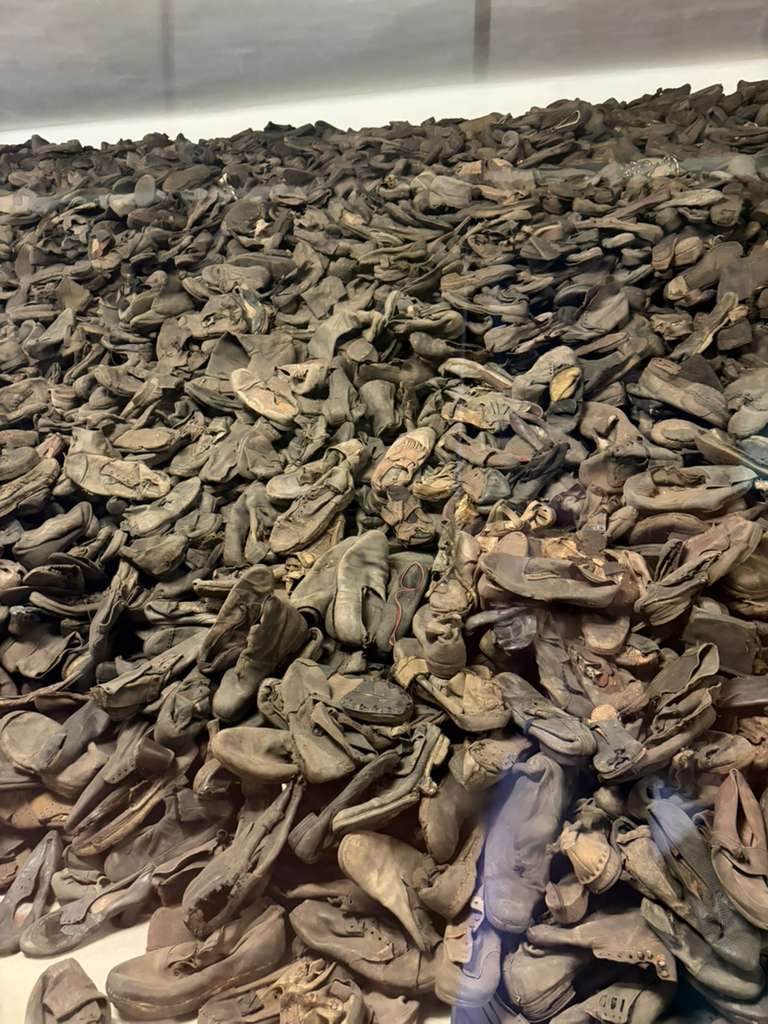
At Auschwitz I, it is easy to be overwhelmed by the scale of what happened. The numbers are almost too large for students, or for any of us, to fully comprehend. But then you come to the rooms filled with ordinary objects: pots, pans, shoes, suitcases, eyeglasses. These are not just museum displays. They are evidence of people who were lied to, people who packed for survival, people who believed they were being sent to a place where work, however difficult, might still mean life.
The pots and pans affected me deeply because they reveal the cruel deception at the center of the Nazi system. Families brought the practical things they thought they would need. A mother may have packed a pot because she expected to cook for her children. A father may have carried a pan because he believed his family would still be together, still sharing meals, still building some version of daily life in an impossible situation. These objects remind us that the victims were not walking symbols of history. They were individuals making human decisions in terrifying circumstances, clinging to the hope that preparation could protect them.
The shoes are even harder to process. Each pair once belonged to a person with a name, a voice, a family, a destination they thought they were reaching. As a social studies teacher, I want students to understand the policies, the ideology, and the timeline of the Holocaust. But Auschwitz also teaches something beyond dates and documents. It teaches that history is lived one person at a time. The horror becomes personal when we stop seeing only the number of victims and begin seeing the lives that were interrupted: the meal that was never cooked, the journey that never became work, the shoes that carried someone to a place from which they would not return.