
In Vilnius, our guide called parks “scars of war.”
The playgrounds we saw, where children descended colorful slides and adults gathered on
nearby benches, were erected after the war. In some of these sites, Jews were rounded up
during the war; these spaces operate in opposition to their past.
In Riga, the ground speaks for itself.
Between 1725 and 1920, Jews were buried in what is called “The Old Jewish Cemetery.”
It’s referred to as the “old” one, Elena, our guide, said because in 1920, after Riga’s Jewish
cemetery reached capacity a new one was opened. For nearly 20 years, the old cemetery
remained, as did its buildings: a small chapel and a work area for members of the local Jewish
burial society.
On July 4, 1941, along with torching local synagogues, Nazis ignited the old cemetery’s two
structures, we were told. A barbed wire fence was erected, and the area which formerly housed
the dead possessed the living.
Moving through Riga we heard more about the ghetto and the fate of its 25,000 Jewish
residents.
After the war, gravestones were piled near the cemetery’s entrance. In the late 1950s,
according to Elena, Soviets bulldozed the land. We heard this while walking along an asphalt
path in the park.
“I remember,” she said, “when this used to be gravel.”
Elena followed the reminiscence with a story: several times while walking the rolling route she
noticed fragmented stones. Differing in color from the gravel, she’d retrieve them. Written on the
pieces were Hebrew letters. She said she’d take the not quite pebbles and place them next to a
memorial in the park.
“You couldn’t put them on top because the stone was round,” she said.
The shards recalled an earlier period; so did the corner of a gravestone, which somehow
remained in the grass. The marker seemed to “pop out” of the earth, our guide said. Written on
the stone was a red Aleph signifying “Isha,” the Hebrew word for woman.
Around the time when the gravel was replaced with asphalt, the park’s grass was also redone.
The ground was covered and the space beautified. Disappearing from view, Elena said, was the
protruding corner of the Jewish burial marker. Time passed. The earth resettled. Then, about 5
years after the municipality ornamented the park, the corner of the Hebrew gravestone rose
again.
Later, Elena told us that shortly after the war Riga Jewish resident Samuel Ceitlin traveled to the
Rumbula forest with his wife and a small group of survivors. They heard that the Riga Ghetto’s
25,000 Jewish residents were killed in the woods. What they found, Elena said, was “just a
forest.”
Ceitlin returned with an agronomist, who noticed flowers growing in “organic soil.”
The small team started digging. They discovered burnt bones and human remains. Sunday after
Sunday, the team returned to dig and discover. Throughout the area were remains belonging to
thousands.
A long process ensued, permission was finally granted, and six spaces were designated to
place the remnants of life.
There’s a memorial in Rumbula. At its center is a seven-branched menorah. The base
resembles roots reaching forth from the ground. Surrounding the candelabra are stones forming
a Star of David. Several stones include the names of Riga’s Jewish residents murdered in the
forest. One stone bears another Riga Jewish resident’s name: Samuel Ceitlin, the man who
unearthed his landsmen and laid them to rest in ground that would tell their story.
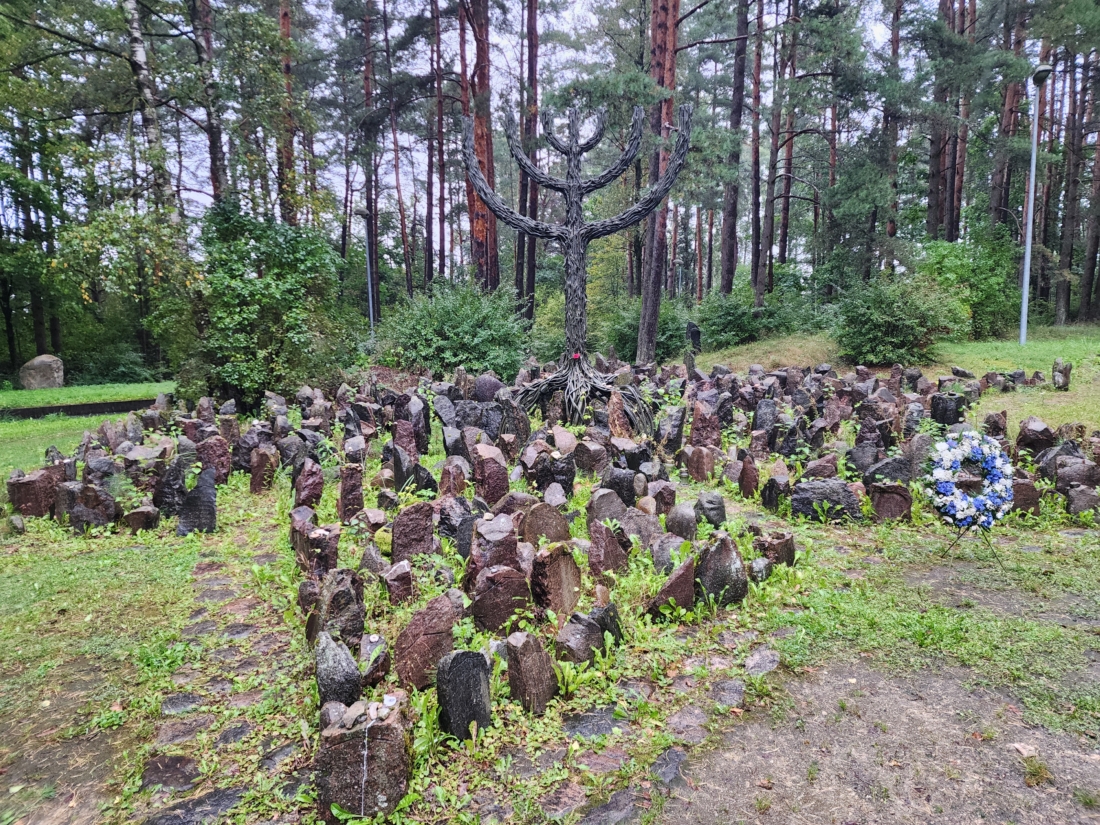
Reaching forth from the ground, this monument honors those murdered in the Rumbula forest. Photo by Adam Reinherz