At first, when you enter Auschwitz, it does not feel real. The images are too familiar: the gate, the railway tracks, the brick buildings, the barbed wire. They have been reproduced so often in films, documentaries, textbooks, and photographs that some part of your mind recognizes them before you can comprehend where you are. You expect reality to feel different somehow. Less orderly. Less preserved. Less clean. Less like the image already embedded in collective memory. But then you begin to learn Auschwitz as a place, not just as a visual.
You walk through rooms upon rooms that reveal the scale of the violence committed against innocent people there. You see human hair. You see clothing. You see the ordinary things people packed because they believed they would need them: toothbrushes, combs, prayer shawls, cooking pots. Objects of daily life. Objects of routine. Objects carried by people who still understood themselves as people with a future.
That may be what stayed with me most: the evidence of hope. People packed because they thought they were going somewhere. They brought what they would need to wash, to cook, to pray, to care for their children, to continue. They did not arrive as symbols or statistics. They arrived as mothers and fathers, grandparents, sons and daughters. They arrived carrying the small, practical items of ordinary human life.
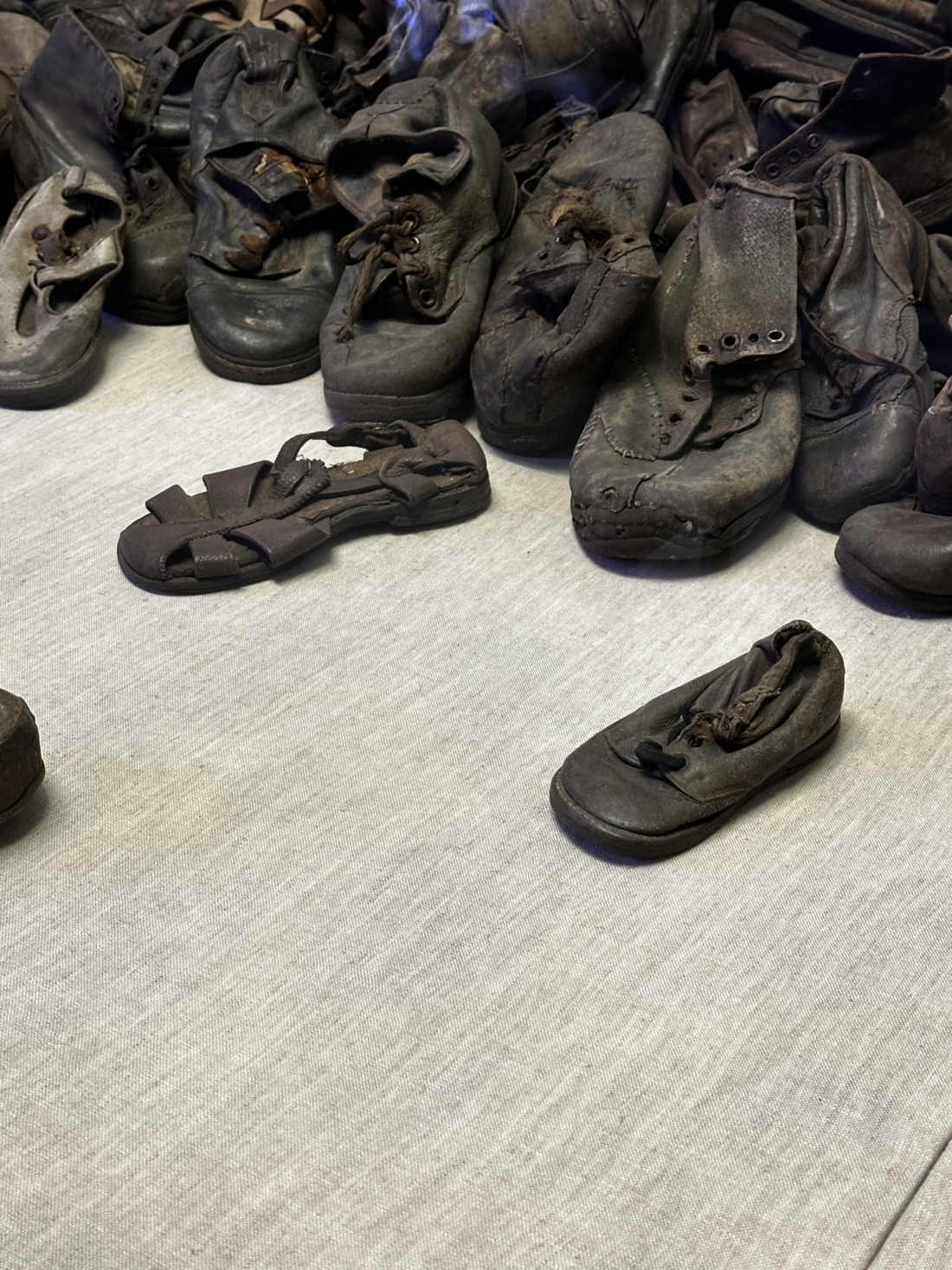
And then you see a tiny shoe. It looked almost identical to a pair I bought seventy-five years later for my own daughter. For a moment, history collapsed. It was no longer possible to think in numbers, dates, or political categories. That shoe belonged to a child. A child whose mother chose it, packed it, buckled it, worried over it. A child who should have outgrown it.
Auschwitz did not only take lives. In the final minutes before death, it destroyed the hope people were still carrying with them.
I do not want to pretend that visiting means I understand. I do not. If anything, standing there made the limits of understanding feel sharper. There are places where language fails, and Auschwitz is one of them. But silence feels wrong too, because what happened there depends on being remembered truthfully.
To remember Auschwitz is not only to feel sorrow in its presence. It is to tell the truth about what human beings did to other human beings when hatred became policy, bureaucracy became a weapon, and dehumanization became the logic of the state. It is to resist every language that makes people seem less than human. It is to refuse the comfort of distance.
They were not only victims. They were people. They had toothbrushes and cooking pots and prayer shawls and children’s shoes. They had names, families, languages, traditions, obligations, and plans for tomorrow.
Auschwitz was built to make sure tomorrow never came. Yet Auschwitz failed at its ultimate objective. It did not destroy the Jewish people. It did not erase the people the Nazis marked for annihilation. It did not kill memory, faith, or the possibility of a world that would look back and name what happened there as evil.