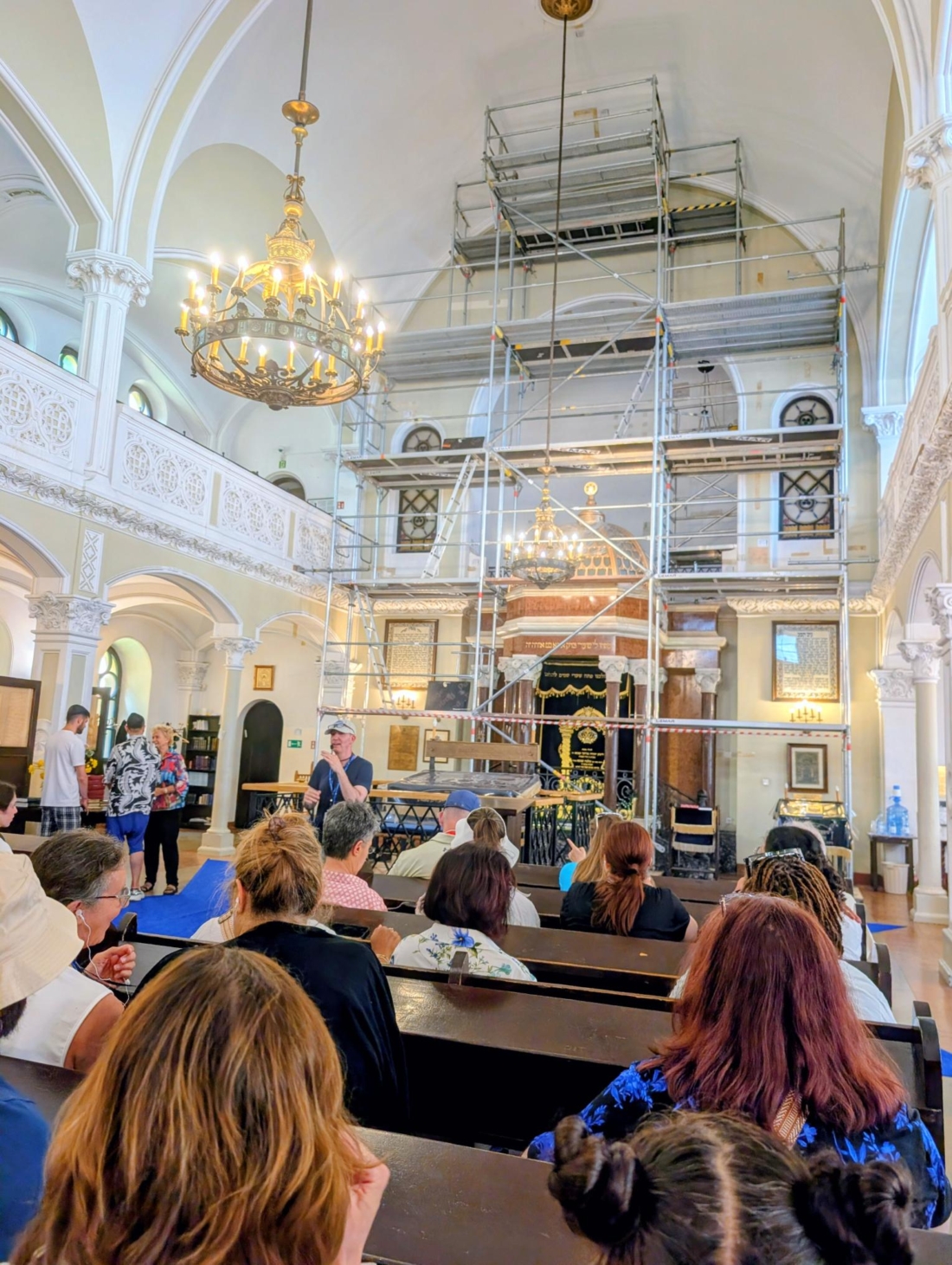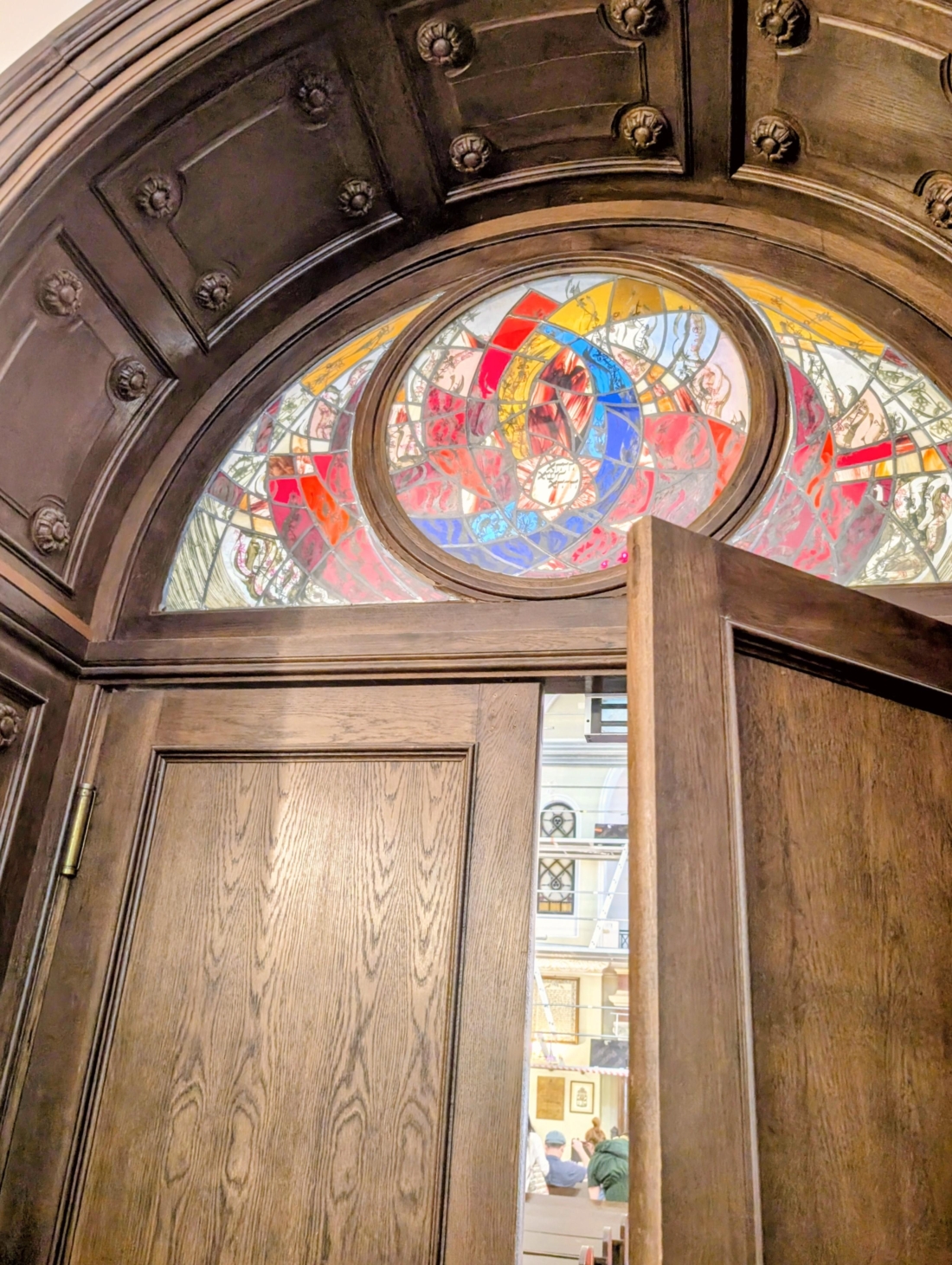
Outside, Warsaw is loud, vibrant, and moving at a joyous pace. Just minutes before, our Classrooms Without Borders cohort was navigating a bustling grid of modern life; past families laughing on sidewalks, the chatter of crowded outdoor restaurants, and the ambient hum of a thriving European city. It is a beautiful scene of a metropolis that has completely rebuilt itself. But then, we turned a corner and stepped off the busy pavement, and walked into a profound, sudden silence. We were standing inside the Nożyk Synagogue.
This was my very first time ever stepping foot inside a synagogue. As someone traveling to learn, absorb, and bear witness, I felt a rush of complex emotions the moment we crossed the threshold. Sensing the gravity of the moment, our guide, Avi, gathered us together and quickly went over what to look for, helping us ground our senses in an unfamiliar spiritual home.The very first thing that caught my eye was the light. Massive, bright windows punctuate the walls, flooding the sanctuary with daytime glow. I knew that during the war, these windows were surely shattered by gunfire and explosions, but looking at them now, completely fixed and pouring with light, felt like the ultimate symbol of repair. Unlike the heavily gilded, ornate cathedrals you often see in Europe, the space felt remarkably humble and clean, it was not overly decorated. Instead, it felt functional, peaceful, and honest. Look a little closer, though, and you see the marks of ongoing care. There was still some scaffolding set up around the interior. It served as a visual reminder that preserving history is an active, continuous job. Being in this room is an overwhelming feeling because you quickly realize you are standing in a place of astronomical luck. This was one of the lucky ones.
Before World War II, Warsaw was home to many synagogues. Every single one of them was burned down, blown up, or systematically erased from the earth. Why did this one survive? For decades, a popular story circulated worldwide that the Nazis left it standing because they used it as a stable for military horses. But as we learned on this trip, that is actually a myth. It is a tale told about conquered synagogues all over the world, but logistically, the occupying forces simply did not need that many stables. The truth is much more haunting: we don’t actually know why it was left. History kept this secret, leaving the building behind as an unexplained miracle.
The deeper beauty of the Nożyk Synagogue lies in its origin story. At the turn of the 20th century, a Jewish textile merchant and his wife, found themselves facing a quiet grief, they had no children. Wanting to leave a legacy and ensure their name would be carried on after they passed, they donated their life savings to build this synagogue. They wanted a building to preserve their memory. In reality, their gift did infinitely more than that. When the fog of World War II finally cleared, and the traumatized, grieving survivors of the Holocaust began trickling back into the rubble of Warsaw, they had absolutely nothing left. Their homes were gone, their families were gone, and their communities were shattered. But the Nożyk Synagogue was still standing. Because of this couple, the Jewish people had a roof over their heads, a floor beneath their feet, and a physical place to come back to. It gave a displaced community a tangible anchor to begin the painful, beautiful process of rebuilding Jewish life from the ashes.
What makes the Nożyk Synagogue truly extraordinary and what aligns so deeply with the mission of Classrooms Without Borders is that it remains a living monument. Decades after the world thought Jewish life in Poland was entirely extinguished, it is still active. It stands as a triumphant, defiant message to the world: We are still here. It teaches us that education is our most powerful tool against hatred, and that remembering the past is a prerequisite for building a better future.