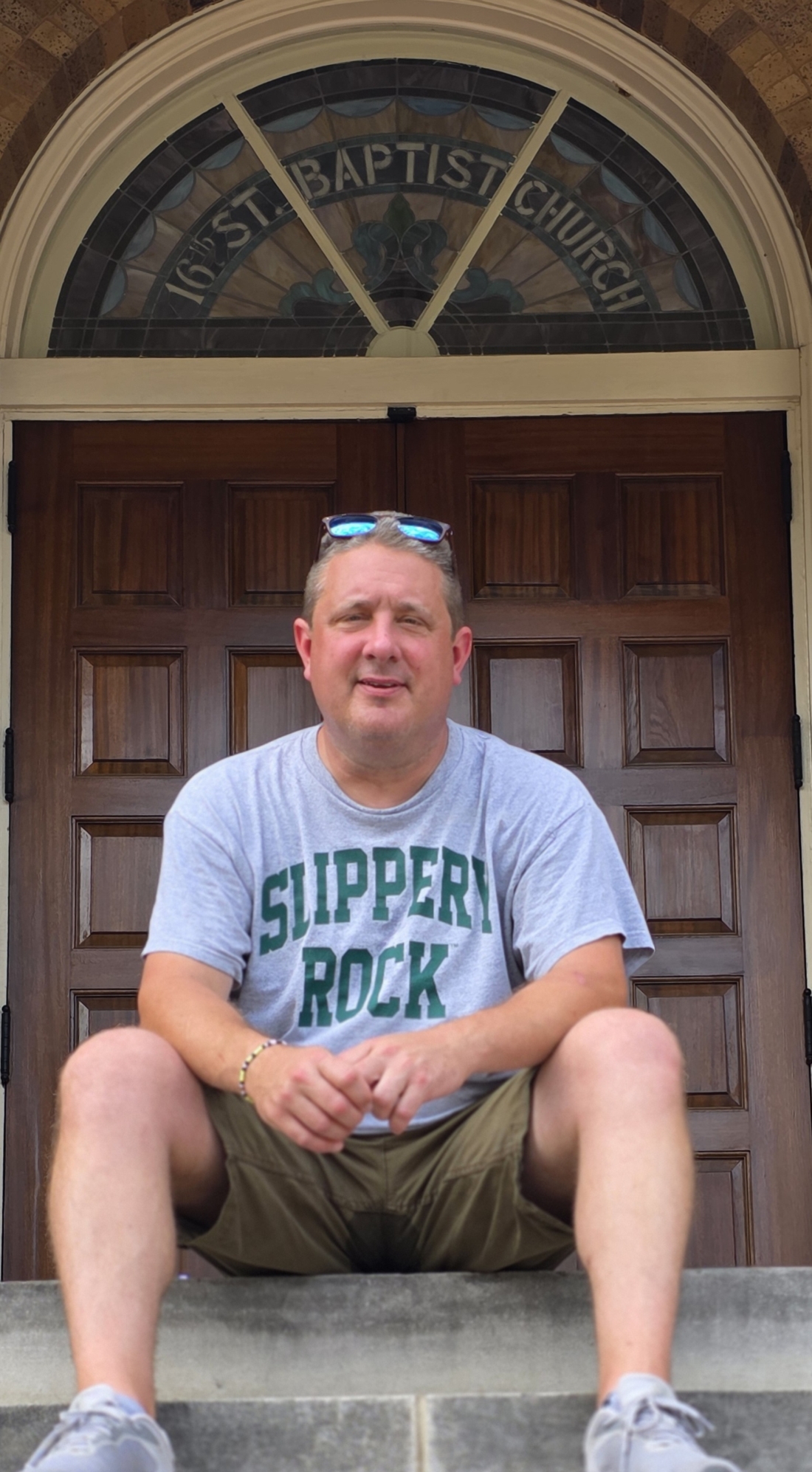
Once again, Classroom Without Borders has delivered to this student of history a life changing experience that has led me on a journey of self reflection, and self purpose. The deeper motivation / meaning behind my life, my actions, my family, my purpose and my goals have become more clear and cherished. I felt it necessary to write the parallels between my trip in 2016 on the Poland Personally seminar to last month’s journey through the American South via the Marching Down Freedom’s Road seminar. They are astonishing and will stick with this educator and elected official forever. It took some time for me to reflect and organize my thoughts and memories of the two trips, but it was worth it. Witnessing Auschwitz almost 10 years ago, and now the historic sites of the American Civil Rights Movement reveal powerful and sobering parallels. They both bear witness to humanity’s capacity for cruelty, but also to its ability to resist, to remember, and ultimately, to love and rebuild.
Both Auschwitz and sites like the Edmund Pettus Bridge in Selma, the 16th Street Baptist Church in Birmingham, or the Lorraine Motel in Memphis are more than historical markers, they are sacred ground. They are physical spaces that serve as witnesses and hold the memory of suffering and courage. There is a profound stillness or weight in these spaces, a silent testimony to what took place there. These places demand reflection not only on the horrors of the past, but on the endurance of the human spirit.
In both histories, hate was codified into law and social systems. Auschwitz and other camps stands as the most chilling symbol of the Holocaust, where racial hatred that was driven by anti-Semitism, nationalism, and fascism was weaponized into genocide. In the American South, racial segregation, lynchings, and the violent suppression of Black Americans were upheld by Jim Crow laws and a legacy of slavery. In both cases, entire systems were designed to dehumanize and marginalize entire populations. The perpetrators believed in their moral or racial superiority, and state institutions were used to enforce that belief through terror.
Despite the brutality, these places also hold the stories of resistance, hope and love. In Poland, people risked their lives to hide Jews, and in the camps themselves, prisoners engaged in acts of quiet defiance attempting to preserve their dignity, their faith, their culture. And in many cases they did just that. In the South, the Civil Rights Movement was a nonviolent moral revolution. Led by figures like Dr. Martin Luther King Jr., Rosa Parks, John Lewis, and many unnamed others confronted hate not with vengeance but with peace, love, and unshakable hope for justice. The marches, sit-ins, and voter registration drives were acts of radical hope. The idea that love could triumph over hate was not sentimental. I learned that it was strategic, courageous, and deeply moral.
Both sets of sites force a reckoning. They challenge us to confront their histories honestly, not to be paralyzed by guilt, but to be transformed by it. In Poland and Germany, the Holocaust led to national soul searching, memorialization, and education, though not without struggle. It also led to the restoration of the Jewish homeland through Israel in 1948. In the U.S., the process has been more fraught, but through Civil Rights museums and memorials like the National Memorial for Peace and Justice in Montgomery we aim to tell the full story.There is still so much more to be done to ensure civil rights to all Americans but the efforts of the leader in the cause motivate us to fulfill the dream. Our memory becomes a tool of justice because remembering helps prevent repetition. It helps heal. It helps when our leaders see the parallels and adjust their thinking and voting so that the scars of the past do not reopen, but serve as a reminder of what we did to each other not so long ago.
I would like to acknowledge two folks at Classroom Without Borders leadership. Mrs. Kate Lukaszewicz who served as a CWB’s guide for the Marching Down Freedoms Road seminar, just two weeks. Kate also toured with me in Poland as a teacher in 2016. We were under the guidance of Dr. Tsipy Gur on the Poland Personally tour. Both women are remarkable people, and great friends of mine who are doing God’s work and should be recognized.
These sites are not relics, or tourist destinations. They call you to the present by their shared hallowed existence. You leave with a burden and a responsibility: To oppose hate and intolerance in all its modern forms. To honor the victims by building societies rooted in dignity, equality, and love. To live with a purpose, as those who marched in Selma or suffered in Auschwitz did not in fear, but with hope. To walk through Auschwitz, or across the Edmund Pettus Bridge is to touch the extremes of human history: our capacity for cruelty and our capacity for compassion. Both journeys have taught me that though hate can build walls, it is love that tears them down, and it is our memory that ensures we never build them again. Hearing firsthand accounts from people who lived through the era like Auschwitz survivor Mr. Howard Chandler or the local guides, foot soldiers in Selma such as Dr. Lynda Blackmon Lowry, and Charles Mauldin, or the innocent bible school/bomb survivor, Rev. Carolyn McKinstry makes history come alive. Their stories added depth and realism that go far beyond dates and legislation. It’s not just learning, it was honestly a second transformation for me. That’s what makes it unforgettable.