How do so few people make such a sound? The Helsinki Jewish community totals less than a
1,000 yet its presence is palpable.
As we discovered, the Jewish school, which serves students roughly ages 6 to 15 doesn’t have
more than 100 children. Weekday services at the adjacent synagogue welcomed slightly more
than a minyan. On Wednesday evening, perhaps a dozen teens met to discuss youth group
activities. One day earlier, a school board meeting attracted maybe 10 participants. The Jewish
community’s choir actually featured close to 40 talented singers. But on the next evening, during
communal Torah study with two teachers, about 16 people — counting those in-person and
online — attended. A women’s challah bake, occurring shortly after we arrived, welcomed
almost 15 people. Some attendees spilled into Cafe Kesher, a newly-opened kosher haunt in
the school’s basement, but the number of pastry eaters wasn’t more than 12.
Jewish Helsinki consists of pockets of people. Ranging in age, place of origin and interests, the
commixture is something most diaspora Jewish hubs would crave.
“The idea is to have a safe space for everyone,” Chaya, the community’s leader, told us.
From our limited time together, it appears the idea is working.
This isn’t to say Helsinki doesn’t have problems. There are plenty, we learned, including rising
antisemitism, hyperfamiliarity and making sense of its own past.
Given small class sizes, adolescent socialization is challenging, a school staffer told us. The
sentiment, she continued, is often conveyed as, “I don’t want to marry my brother.”
Speaking to our group, an academic told us a recent survey indicated most Finns believe
antisemitism has increased during the past five years. Still, considering the country’s stellar
educational reputation, most local residents are shocked to hear xenophobia and other hatreds
exist.
A mid-30-year-old is among the only members of the Jewish burial society under the age of 70.
Jewish teachers in the Jewish school struggle finding Finnish-language materials related to
Jewish subjects. When the school was opened 100 years ago, its Jewish-literate students
simply needed a place to study natural sciences, mathematics and languages. Today’s students
have a background in those subjects but largely lack an understanding of Jewish life.
Speaking during evening Torah study for the community, Rabbi Shmuel said he remembers
speaking with a student who’d never heard of Rosh Hashanah, had no idea about the shofar but
somehow knew about dipping apples in honey as a religious practice.
Because the Jewish school is public, and follows a Finnish curriculum, Judaism can only be
taught in a non-confessional manner. Meaning, as one educator told us, instructional Jewish
practice is largely delivered during break times, never during official periods.
The synagogue follows an Ashkenazic tradition. Selichot, however, operated according to
Sephardic norms. Supposedly only three people in the congregation lead services on Shabbat,
we were told, and the only tunes they employ are those most North American shul-goers would
recognize from the high holidays.
Every hour in Jewish Helsinki revealed another oddity. A recently hired community educator
regularly teaches Torah but few people know she’s an ordained Orthodox rabbi. Educators in
the Jewish school largely don’t consider themselves Jewish professionals, rather Finnish
teachers who work at a Jewish school. Printed inside the community’s prayer booklet,
immediately following grace after meals, are the words to “Oseh Shalom.”
Community representatives told us the Hebrew folk song has been sung so many times upon a
meal’s conclusion that the line between custom and law is basically obscured.
Time in Jewish Helsinki raises so many questions. The biggest, for now, is after seeing
seemingly mismatched pockets of Jewish life harmoniously appear, how does the Jewish world
follow the city’s lead?
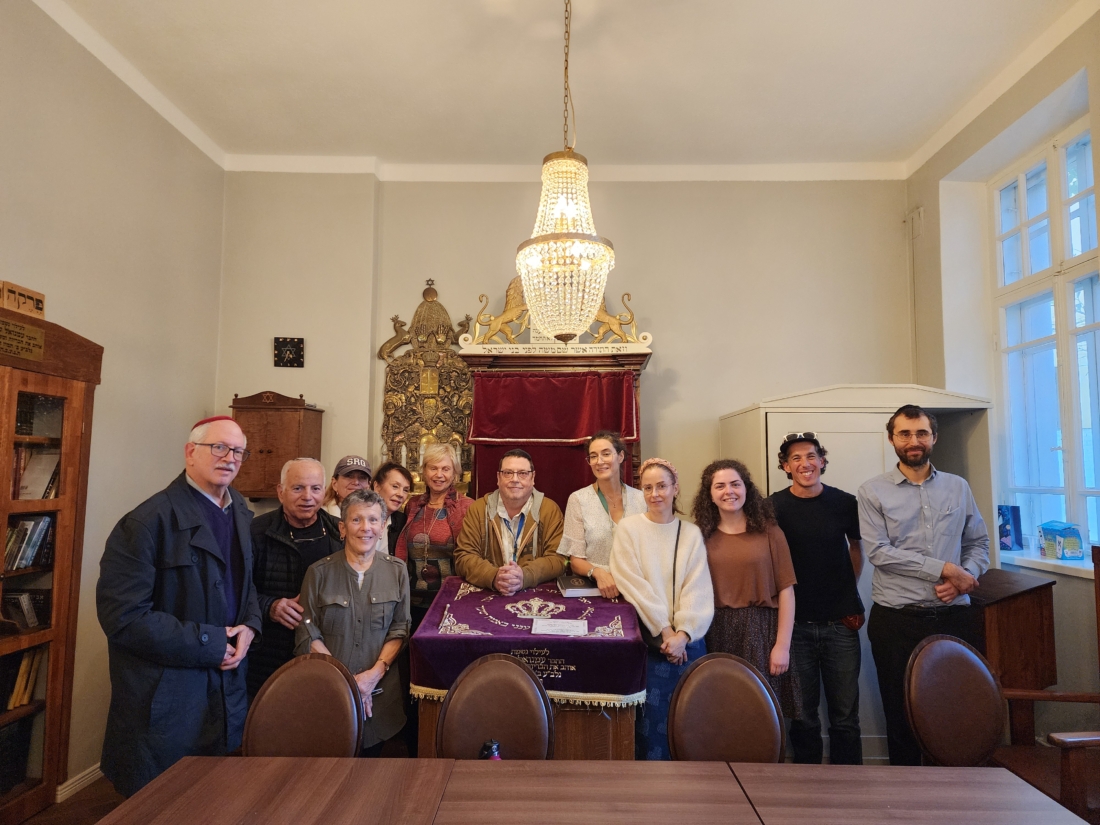
Educators and communal representatives from Jewish Helsinki meet CWB. Photo by Adam Reinherz