
As a middle school ELA teacher, I spend a lot of time helping my students explore the depth of Holocaust literature. We talk about memory, loss, resilience, and the responsibility of bearing witness. These themes are powerful in the classroom, but it was not until I visited a Jewish cemetery that I truly understood how deeply they live in the real world.
The visit was not just informative. It was emotional. It took the history I teach and placed it right in front of me in a way that was impossible to ignore.
Many of the gravestones were cracked, faded, or covered in moss. Some had inscriptions and Jewish symbols, but others were so worn they were hard to read. Grass grew tall between them, and vines curled across the stones. It became painfully clear that this was not just the passage of time. It was the absence of people. The families who would have cared for these graves are gone. Entire communities were wiped out during the Holocaust. There is no one left to visit, to tidy the space, or to whisper the names out loud.
Among the gravestones were also mass graves. These were not marked with individual names, but instead with earth covered by stones. In Jewish tradition, placing a stone is a sign of respect and remembrance. Seeing these stones gathered across the graves was deeply moving. Some belonged to people with names. Others never had the chance to be identified. It was a visual reminder of the enormous scale of the loss and how many stories were never told.
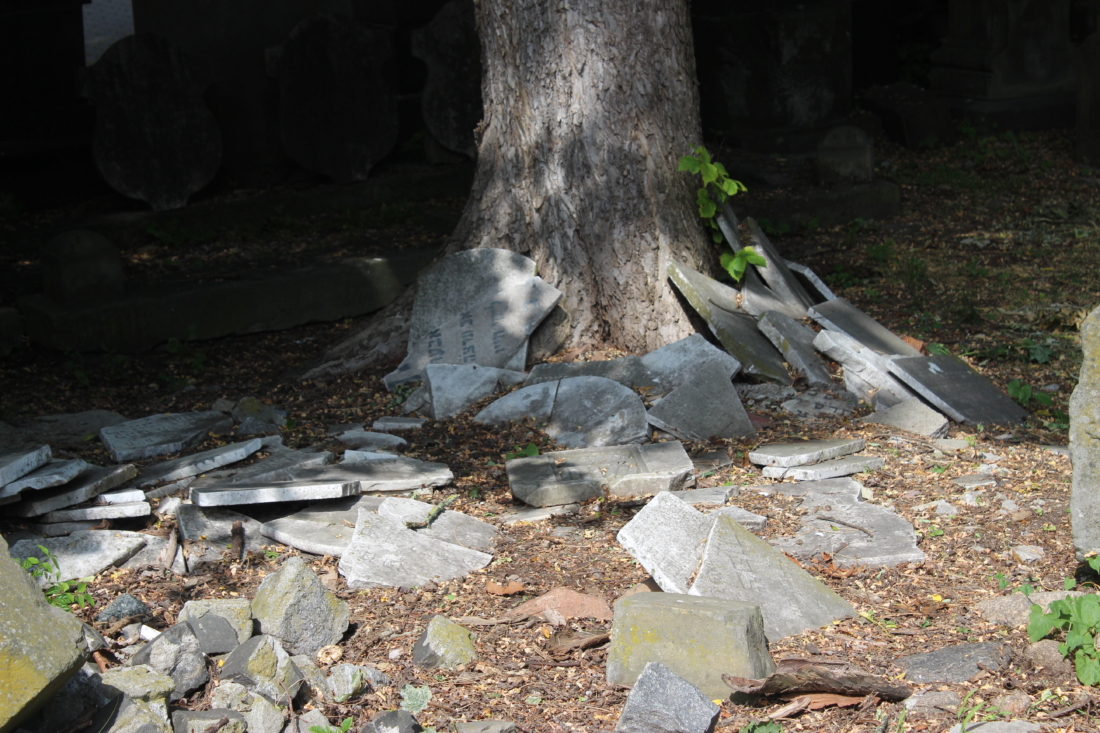
This cemetery showed me that history is not only found in books. It lives in places like this. It is written in the earth, in the silence between headstones, in the empty spaces where a family should have been. It is in what is left behind and what has been forgotten.
More than anything, this visit reminded me why I teach this history. I want my students to see that remembering is not just about knowledge. It is about compassion. It is about choosing to speak the names, to ask the questions, and to never let silence win. Bearing witness is one way we keep the memory alive. It is one way we say, we still see you.
This moment inspired the poem below:
And what of the cemeteries?
Stones crumbling like memory.
No hands left to clean them.
No voices left to speak the names.
Only wind,
and moss,
and the ache of forgetting.
A cemetery with no visitors
is a second grave.
It is a question:
Did we survive only to be forgotten?
It is a cry:
Please say our names out loud.
Don’t let the stones go silent too.
But the story does not end in ash.
It ends in your voice.
It ends in the hands that clean the stones,
in the lessons passed down,
in the choice to remember
even when it’s easier to look away.
This is not just history.
It is inheritance.
It is responsibility.
It is the act of holding space for ghosts
and planting flowers where they once stood.
We speak,
because silence never healed a soul.