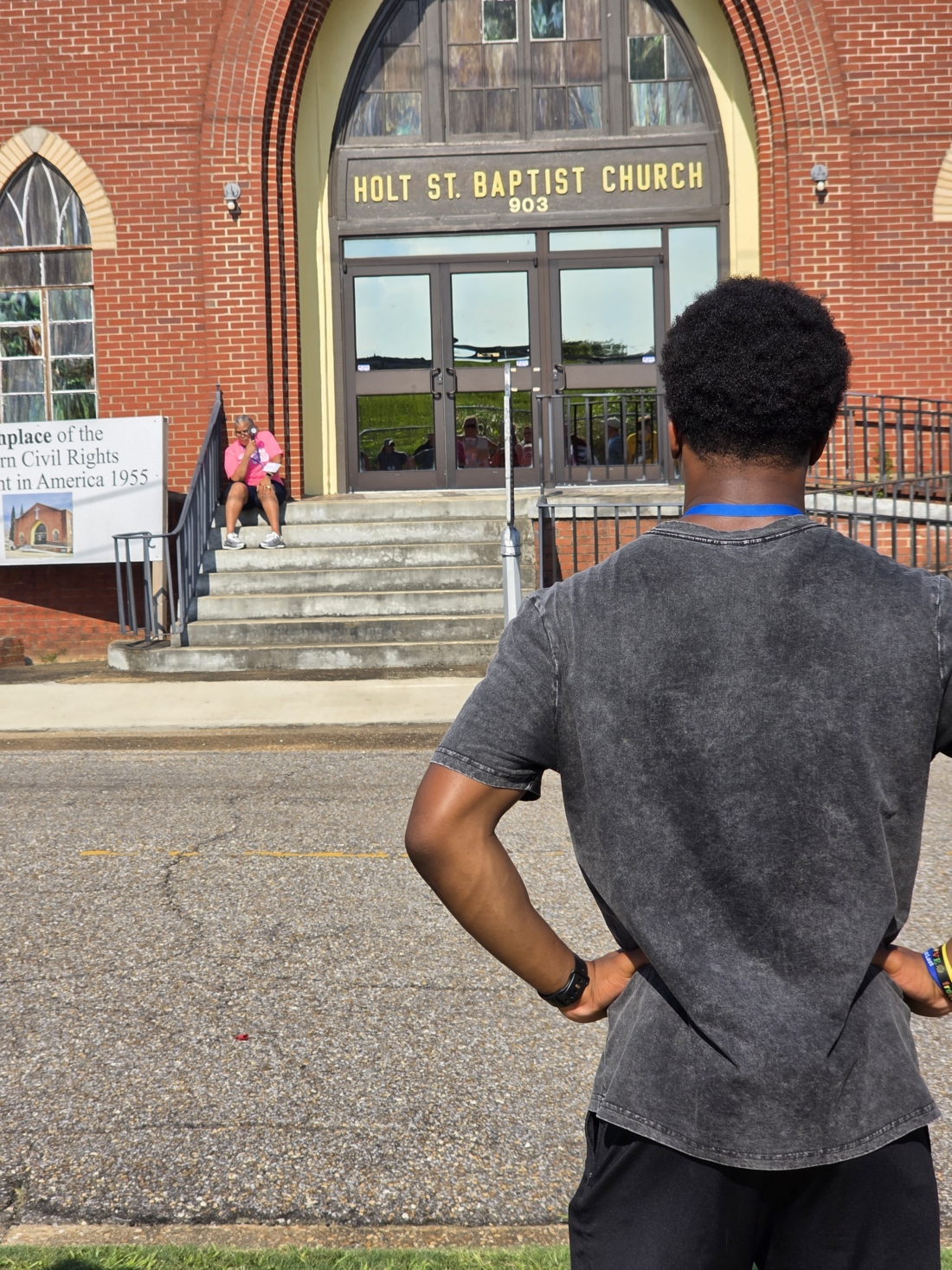
The first day when we arrived in Atlanta, GA, we went to the MLK Jr. memorial and saw the house he grew up in, which is currently under reservation. We also explored a small museum that had artifacts from when MLK Jr. was still alive, including clothing and accessories. Across from the memorial was the church where he preached. Although we weren’t able to enter the church, it was nice to see, and it’s still a place of worship to this day.
After the memorial, we went to see a mural of John Lewis, a civil rights icon. He was arrested multiple times, but that did not stop him on his journey to fight for freedom and equality. We then ate at The Tea Room and learned about Charles Person. Mr. Person was a freedom fighter and activist when he was younger. He and many other brave young men protested for what was right.
The next day, we arrived in Montgomery, AL, and walked to the capitol building, where the Selma to Montgomery march concluded. The day after, we went to Lowndes to learn more about its history. Lowndes had the nickname “Bloody Lowndes” because activists who fought for their voting rights were attacked and beaten. During the march, people would stay in tents after reaching their daily destination.
After visiting the museum, we went to Selma, AL, and arrived at Amelia Boynton’s home. She was a prominent activist in the civil rights movement, and her house recently started renovation after being uninhabitable for some time. We then went to Foot Soldiers Park, where we had the honor of hearing Lynda Lowery speak. She was the youngest person in the march from Selma to Montgomery. I got the honor to speak to her personally and learn a few things from her. She told me that it starts with the youth, but we have to get it together.
We also visited the church where mass meetings were held and where Ms. Lowery grew up. We then crossed the Edmund Pettus Bridge, which felt powerful and honorable. After crossing the bridge, we went to a museum at the end of the bridge.
We started the next day at The Legacy Museum in Montgomery, AL. It was a sacred space, so phones were prohibited. The museum presented a timeline through slavery and how it’s still prevalent today. Slavery began with the Transatlantic Slave Trade, during a time when many were separated from their families and some died during the voyage. Black people were enslaved for labor on plantations, which was central to the development of the Americas. Slavery has left a lasting image of racial and economic inequality. Slaves built Broadway, Wall Street, and many other places that are still prominent today. The creation of the cotton gin and the inflation of cotton prices created a demand for more Black labor.
Montgomery, AL, was one of the most active human trafficking sites from 1820-1860, and slaves made up two-thirds of the population. Enslavement lasted more than two centuries in the United States and created generational wealth for White America. The southern economy relied on cotton, sugar, and tobacco, all labored by enslaved African Americans. African Americans were seen as not human, lazy, child-like, and undisciplined, while Whites were viewed as smart, hard-working, and intellectually evolved.
During the Civil War, southern states seceded from the Union to preserve slavery in 1861. The Confederacy surrendered only four short years later in 1865, the same year the 19th Amendment was incorporated. During the Reconstruction Era, Congress abandoned the promise of assistance for Blacks, as many were attacked and killed by white mobs such as the Ku Klux Klan. The Civil Rights Act and 14th Amendment were not enforced, which led to the Great Migration from 1910-1940, when six million people fled the South. African Americans were still being oppressed due to Jim Crow laws that restricted their natural-born rights. Many people participated in sit-ins to protest segregation. To this day, African Americans still face oppression, as two-thirds of people in prison for drug offenses are people of color. The war on drugs is fueled by the desire to criminalize Black people. We will keep Breonna Taylor, George Floyd, Kimani Gray, Trayvon Walker, and all the other people of color whose lives were taken away from them due to racist antics.
Our next destination was The More Up Campus, signifying African American healing practices that were acts of resistance. The campus is symbolic of the mothers of gynecology and their healing garden. African Americans were not allowed to be treated by white doctors, which led to significant mortality rates due to improper care. Mothers trained daughters in herbal medicine, passing it down through generations. “Look back in order to move forward.” Experiments on women and girls of color were performed to push the development of birth control.
Our last destination was a memorial site for the enslaved and oppressed who were killed just because of the color of their skin. The memorial had a sad and heavy vibe. Just looking at all of the names and stories of the African Americans who were trying to fight against an inhumane system was moving. They all had families, mothers, fathers, and lives.
The next day, we went to another museum bright and early. We were not allowed to take many pictures, but it was breathtaking. There were so many symbolic pieces of art, and experiencing walking in a house that the enslaved lived in left me speechless. At the end, there was a memorial paying tribute to the enslaved who were freed and picked their surnames. My surname “Bottoms” was on the memorial, and it truly meant a lot to me. I am a part of history, and I will wear my name proud.
We then rode to Birmingham and heard Mrs. Carolyn McKinstry’s story. She was a victim of the 16th Baptist Church bombing, and it took her some time to cope with what happened that day. It was lovely to hear her story and how she is still making an impact today. After hearing her story, we went to see the 16th Baptist Church.
The next day, we went to a synagogue and learned more about the Jewish community’s role in the Civil Rights Movement. The Jewish community played a prominent role in advancing the movement, providing resources and places of security for African Americans. We also heard Charles Mauldin’s story about being an activist and marching across the Edmund Pettus Bridge.
On the last day, we walked across Beale St. in Memphis, TN, where we saw the First Baptist Church and pictures of prominent figures in the movement. We then went to the “I Am A Man” monument, which stands by a church that was bombed not long ago. We then went to the National Civil Rights Museum. The museum was really powerful as it showed iconic figures during the movement and how they contributed. It was really informative and meaningful. We also got to see the room that Dr. King stayed in at the Lorraine Motel.
We then went to the Stax Museum, which was a big music label during the Civil Rights Movement. It was nice to see how figures like Otis Redding and Sam Cooke used their voices to convey such deep messages. It was also interesting to see the style of dress and fashion. We concluded the day by looking at pictures from Ernest Withers. All of his photos had meaning to them.