

- This event has passed.
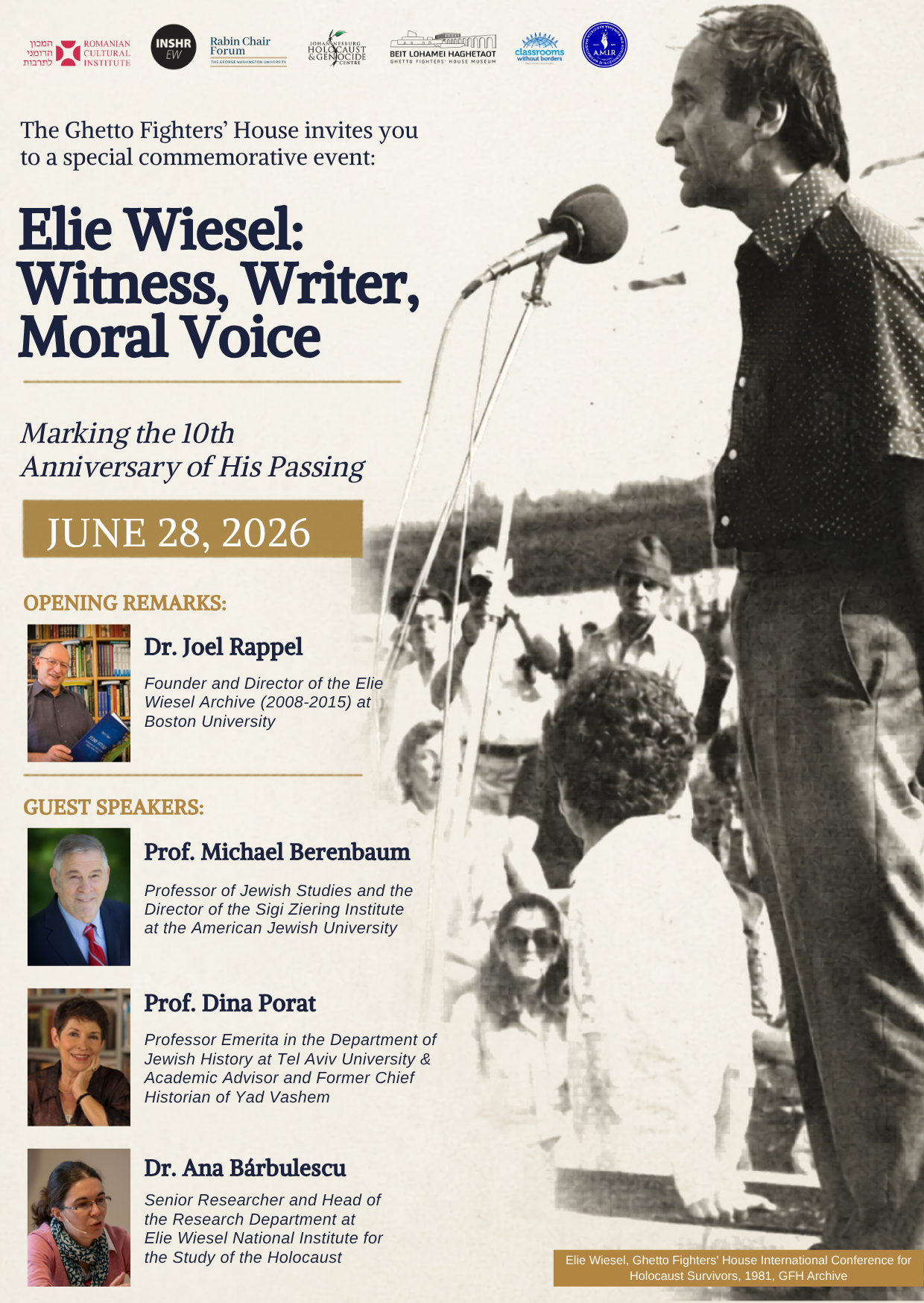
Elie Wiesel: Witness, Writer, Moral Voice Marking the 10th Anniversary of His Passing
Sunday, June 28 @ 2:00 pm EDT
You will be redirected to an external site to register
RegisterTen years after the passing of Elie Wiesel (1928–2016), one of the most influential Holocaust survivors and moral voices of the twentieth century, the Talking Memory International Lecture Series invites you to a special program exploring his life, legacy, and enduring impact on Holocaust memory and contemporary moral discourse.
Dr. Yoel Rappel
The program will open with remarks by Dr. Yoel Rappel, who knew Elie Wiesel for more than thirty years, worked with the Elie Wiesel Archive at the Howard Gotlieb Archival Research Center from 2008 to 2015, and has written extensively about Wiesel’s life and legacy.
Drawing on both personal acquaintance and scholarly engagement, Dr. Rappel will address the question, “Who Was Elie Wiesel?” Exploring the many dimensions of a man who became a witness to history, a celebrated author, a public intellectual, and a global advocate for human dignity, he will offer unique insights into Wiesel’s remarkable life and influence.
Prof. Michael Berenbaum
Prof. Michael Berenbaum will discuss Wiesel’s significance as a writer, the vocation that established his reputation and anchored his existence.
He will also examine Wiesel’s Nobel Peace Prize-winning career as a public intellectual, his role as a voice for Holocaust survivors, and his unique place as a moral laureate of the Jewish people.
Prof. Dina Porat
Prof. Dina Porat will explore the profound questions that accompanied Elie Wiesel throughout his life after liberation:
Was he primarily a witness or a writer? What mission did he see for himself, and what legacy did he hope to leave to future generations?
Through a comparative examination of the reflections of Primo Levi, Aharon Appelfeld, and Abba Kovner—who grappled with similar questions—Prof. Porat will illuminate the distinctive nature of Wiesel’s self-understanding and literary vision.
Dr. Ana Bărbulescu
Dr. Ana Bărbulescu will explore how the Elie Wiesel National Institute for the Study of the Holocaust in Romania embodies Elie Wiesel’s conviction that historical memory must serve as an active ethical safeguard rather than a passive archive.
Drawing on Wiesel’s belief that “the opposite of love is not hate, but indifference,” she will examine the Institute’s role in transforming Holocaust remembrance into a living commitment to historical justice.
With an archive of more than one million official state documents, the Institute serves as a unique bridge between scholarly research, public policy, and educational initiatives, ensuring that the memory of the victims continues to inform contemporary understanding and responsibility.
Join the Conversation
Join us for a thoughtful and timely conversation honoring the life, work, and legacy of Elie Wiesel, whose voice continues to challenge, inspire, and guide us in confronting the moral questions of our time.